P&S Hospital |
|
|
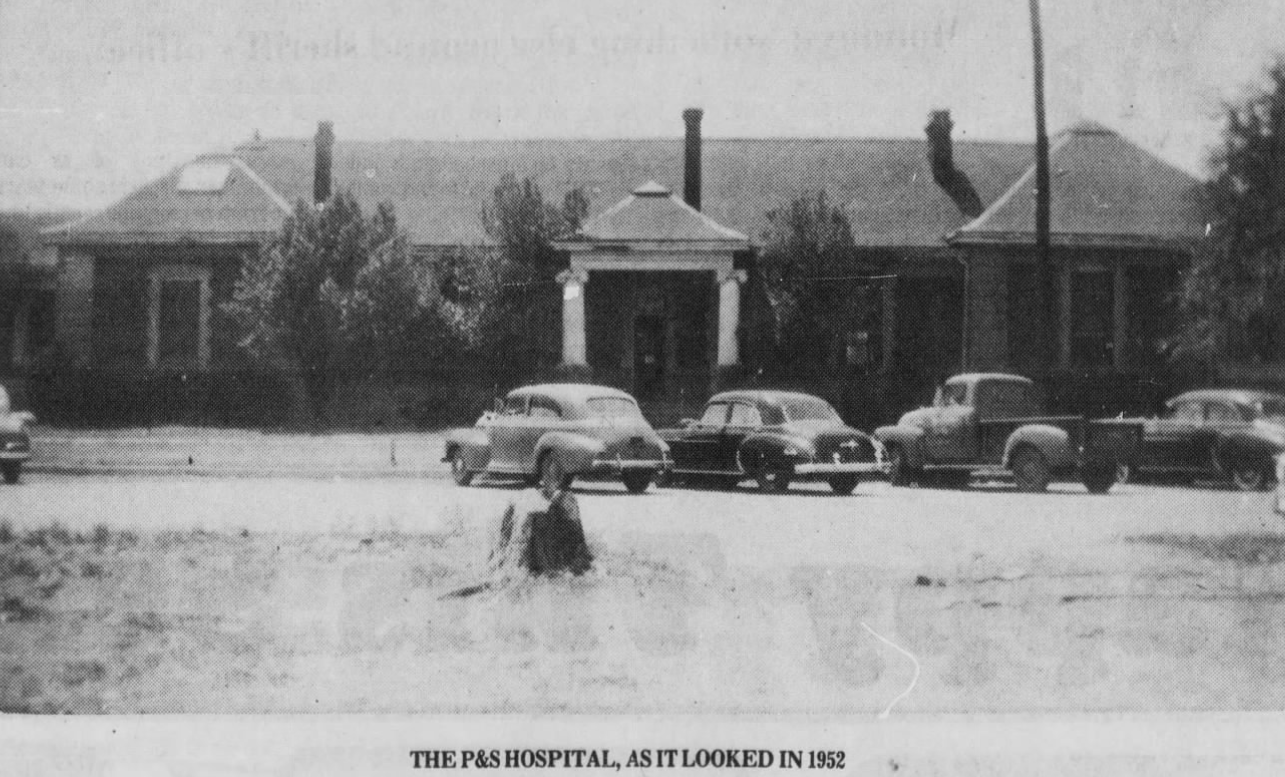
P&S Hospital: born of necessity, died of natural causes For The Sun What was the old P. & S. Hospital like? Mrs. W. Higginbotham, once a nurse at the hospital, said, "The old P. & S. acquired its own personality and its own reputation from all of us who used to work there. "I would say that it was born of necessity, lived 37 years and died of natural causes.” Few people in Corsicana remember the birth of the old hospital. Many recall its passing. All have their own special memories. Among those who have fond memories of the institution is Mrs. Higginbotham herself. She is the only still‑active nurse that made the transition from P. & S. to Navarro County Memorial Hospital. ONE OF THE supervisors of the surgical floor at Memorial, Mrs. Higginbotham said, "I well remember the day that H. R. Stroube, Sr. said to some of us nurses: ‘I’m going to see that you girls get a nice new hospital to work in.’ And with the help of Paul Moore and other members of the hospital board, he did just that.” She said Stroube realized the need of a more up‑to‑date, better equipped hospital when his son, H. R. Stroube Jr., was hospitalized for injuries he received in an airplane crash in about 1949. "The building was sitting right in the middle of three railway systems, with busy trains lumbering by, switching and whistling almost constantly, day and night. Then, too, in the summer we didn’t have any air‑conditioning, and we had so much dust it was hard to find a place to set our little buzzer fans,” Mrs. Higginbotham said. "And it didn’t do too much good to clean up the place. Dust found all the cracks and crevices.” She added, "Of course, there are some things we shouldn’t tell, I suppose. But I’m sure the people of Corsicana understand some of the problems we had because of those railroads. For example, a doctor would be summoned to the hospital. But if a train were on the crossing — or if two trains were on two different crossings — what could he do? Not much, I assure you. Everything had to be left up to us nurses.” "SO WHEN I had to deliver my first baby while the doctor sweated it out in his car on the other side of the railroad, I found myself prepared for the event. In fear of such a thing happening, the doctors had trained me in what to do. If we ever did anything wrong, I never heard about it.” Another nurse at P. & S. — now retired — Mrs. Edna Benson Gordon, recalled some of the earlier days of the hospital. A graduate of the school of nursing at the old hospital, she remembers the oilfield fire at Chambers Creek. "Thirteen men were burned beyond recognition in that fire. Some of them were brought into the hospital. I think the fire was in the 1920s. I was a young nurse and I recall the atmosphere at the hospital. The feeling was that of helplessness.” Mrs. Gordon also recalled the Frost tornado. At that time, she was a surgical supervisor. She and some student nurses went to Frost on the old H. & T. C. "We rode to Frost in a caboose,” she said. "We brought back the injured patients on cots set up in a boxcar.” MRS. GORDON became a part of the all‑night activities. To her, it was a nightmare. Some of the patients had to be taken across the street to the Calvary Baptist Church. "We were not prepared to care for so many people — about 26 or more,” she said. "There were problems with those suffering and with those grieving for lost loved ones and with those in shock. That was in 1930.” The sons of two original P. & S. staff members also remember the hospital’s early days. Paul Miller, son of Dr. T. A. Miller, recalled in 1913 Corsicana voters rejected a bond issue to build what eventually became the P. & S. Hospital. "But the records show the county bought the old Bisso house in 1914 for $8,500. They paid $1,000 on the property in 1915, and the rest in 1916.” He remembered what the old house looked like. "It was a beautiful, large brick house, located at the junction of East 11th St. and South Avenue. It was just about four blocks from the present bus station, and one block off Highway 75,” he said. HIS DESCRIPTION of the early hospital: "It had a long front porch which was glassed in and turned into wards. There were three beds for women on the north side; three beds for men on the south side. "Inside the foyer — the only sitting room — was a long hallway with a ward on each side. On the north, there were six beds for women, and on the south, six beds for men. There were only two bath rooms: one for the women on the north, the other for the men on the south. Then came the delivery room and the surgical room, together with a dressing room for men — doctors and male employees. "Later, a children’s annex was added, and the hospital itself was enlarged until it could — in an emergency — set up 50 beds.” Paul Miller himself came to the hospital in 1945 as a medical sergeant, having served in the Army during WW II. He recalled the first appendectomy performed in Corsicana — according to the records. "THAT WAS BEFORE the hospital was built,” he said. "And it goes to show just how much a hospital was needed. The appendectomy was performed by my father in his own home. Four other doctors and a surgical nurse — brought in from Dallas — were in the room with him. The patient was our housekeeper, Josie Webster. The place of the operation was a large upstairs room with four large windows to admit light. Later, my sister, Beth, was operated on in the same room. "But even after the building of the hospital, many women elected to have their babies at home. Sometimes, a doctor would have to be away from the hospital for half‑a‑day, an entire day or a whole night.” A case in point was that of Dr. Will Miller. He joined the hospital staff in 1933 when his father died. Like Paul, he was the son of Dr. T. A. Miller. One night, he received a call to come to a home in Black Hills, about four miles from Corsicana. He cranked up his automobile and headed down the country road. The weather was cold; the roads were muddy and slippery. The first thing Dr. Will knew — according to the story — he was in a ditch and couldn't budge his car backward or forward. What could he do? He went to a farm house and asked for help. The farmer said, "Sorry, but I don't help you.” Dr. Will replied, "I'm sorry, but you've got to help me. I must deliver a baby.” THE ENCOUNTER ended when the farmer put Dr. Will on a mule and sent him on his way. The next day at the hospital Dr. Will got a report on his nocturnal activities. The story came to him that one farmer was heard say to another, "You hear that man before daylight this morning? He was a‑riding a mule, and a‑whistling and a‑singing. He must be crazy.” Another young doctor has a somewhat similar experience. Dr. Terry Sanders, son of Dr. Gurley Sanders of Kerens — a member of the hospital staff — was called to come to the country to see a patient. Enroute to the farmhouse, Dr. Sanders found his Model T sputtering and finally stopping in the road. The young doctor walked the rest of the distance only to realize that his patient needed to be hospitalized immediately. "So,” said Miller, he rounded up the neighbors, built a stretcher himself and he and the neighbors carried the patient to the nearest available vehicle, and delivered her to P. & S. Staff member Dr. W. T. Shell not only kept an eye on his patients, but he tried to rear his sons to do the same. In those days, there was no rule to keep visitors out of the hospital. Dr. Shell, wanting to rear his sons to be doctors, insisted on taking them with him on his rounds. "MY BROTHER became a doctor and a member of the staff,” said Rufus Shell, of Corsicana, "but I had other ideas.” Mrs. Higginbotham also remembers the informal atmosphere. "By today’s standards, the atmosphere there might be considered a little too informal, with visitors wandering in and out — even the delivery room. But we had a lot of closeness at P. & S. We knew one another intimately. Our relationships were great.” She added that the right of people to visit at all hours didn’t bother her. "I’ve seen a lot of suffering and death in my time. People in pain need somebody to hold their hands. And at the old P. & S., somebody was always available. The old hospital was a landmark in our progress.” Cornerstone was preserved The white marble cornerstone of the P. & S. Hospital building — razed last August after serving as a landmark for 64 years — was preserved. Many people wanted the stone for sentimental reasons — especially if the names of their relatives were engraved on it. But the cornerstone and a salvaged marble plaque were donated to the Navarro County Historical Society and will be displayed at Pioneer Village. One side of the cornerstone lists the members of the first hospital board: Dr. W. T. Shell, president; Dr. L. E. Kelton; J. S. Callicut; J. M. Hoskins; and A. Stewart. The opposite side lists the members of the county court: R. R. Owen, county judge; Edgar Gray; J. M. Burke; W. R. Payne; and J. W. Elrod. The rectangular marble plaque bears the inscription: "A gift of citizens dedicated to the babies of Navarro County Committee.” No date is recorded on either the cornerstone or the plaque. Beneath the plaque’s inscription are the names of the donors: Mr. C. Brighart; Mrs. George E. Jester; Mrs. J. E. Butler; Mrs. J. M. Blanding; Dr. Homer B. Jester; J. Frank Williams; and W. P. McCammon. |
 Navarro County TXGenWeb
© Copyright
March, 2009
Edward L. Williams & Barbara
Knox